The technology making every South African say "Haibo!" is already in our pockets, our homes, and our workplaces. This show demystifies it. Democratises it. Turns confusion into competitive advantage. And does it in a way no show has ever done before.
Irvan Damon presents. AXIS opens, closes, and drops in. The audience always knows who's who — and that clarity is the trust.
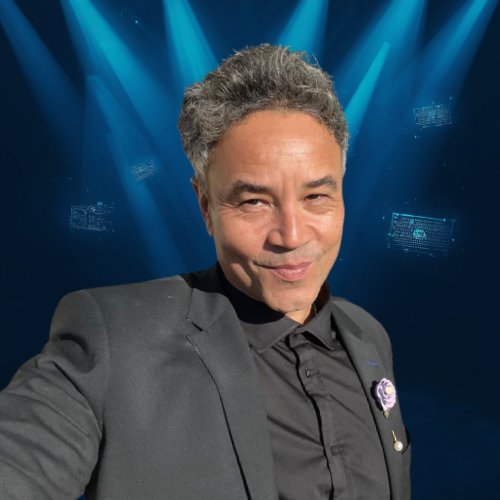
Irvan Damon is always the presenter. Always the human in the room. His AI avatar, AXIS, handles the show's opens, tops, tails, and punctuation moments. The audience never wonders which is which. That is the point. AXIS is the show's signature — the moment viewers know they are watching something built for the AI era. A production device that is also a statement.
The audience always knows Irvan is the human host. No confusion, no gimmick fatigue. AXIS appears in defined, structured moments — so its presence always lands with impact, never dilutes authority.
No African broadcaster has deployed an AI digital avatar as a recurring in-show production signature. AXIS becomes as recognisable as a channel ident — but it speaks, introduces, and signs off. That is ownable, licensable format IP.
A show about AI that uses AI in its own production is self-evidencing. AXIS doesn't explain the topic — AXIS is the topic, functional and present in every single episode, without ever overshadowing the host.
Since you opened this page
The World Economic Forum projects 85 million roles displaced by AI and automation by 2025, offset by 97 million new ones that don't exist yet.
Deepfake content has grown over 900% year-on-year since 2022. The majority target private individuals, not public figures.
The AI industry is projected to contribute $15.7 trillion to the global economy by 2030. More than the current GDP of China and India combined.
ChatGPT alone handles over 10 million queries every 24 hours. Add Gemini, Claude, Grok and Copilot — and the number multiplies significantly.
Voice fraud losses in South Africa topped R2.6 billion in 2023. Your voice can be cloned in under 3 seconds with a free tool on any smartphone.
Platforms like Bubble, Glide and Adalo have crossed 4 million apps built without a single line of code. The developer barrier is gone. Most of SA doesn't know it.
South Africa ranks 65th on the Oxford Insights Government AI Readiness Index. Top-tier for Sub-Saharan Africa. Miles behind the opportunity. HAIBO is the bridge.
At the current rate of production, approximately one new deepfake video is created every 5 minutes somewhere in the world. The clock started when you opened this page.
"The face looks real. The voice sounds familiar. The account has been drained. By the time you know — it's already done."
HAIBO doesn't just show the threat. It trains the audience. By the end of Episode 02, every viewer knows the five tells of a deepfake, has tested a detection tool via QR scan, and has set up a family safe word against voice-clone fraud. This is the episode that turns SABC+ into a national security service.
Deepfake scams surged 3,000% in 2023. Voice clones built from minutes of audio. Remote work created the perfect conditions. The detection tools are losing the arms race. This is not speculation — it is already your company's biggest uninsured risk.
Viewers scan to test a live deepfake detection tool on images and video clips. The episode becomes a hands-on workshop in real time.
SA's Cybercrimes Act (2020) and POPIA provide partial but incomplete protection against deepfake fraud. The episode maps the legal gap and tells viewers exactly where they stand.
Banks, insurers, cybersecurity firms, and telcos are natural AFP partners here. First-party data from QR scans is a qualified lead list of consumers actively seeking fraud protection.
"If the technology doesn't speak your language, it was never built for you. Let's fix that."
Type "Xhosa" into Google Translate. Press play. You will hear "Kosa."
Ask ElevenLabs to say "Qaphela, inja iyaluma" — "Be careful, the dog bites." You will hear "Kaphela."
No clicks. No effort. 25 million speakers, ignored.
English has 44 phonemes. IsiXhosa has over 60 — including 15 click consonants that do not exist in any European language. Big Tech has never meaningfully tried to solve this. There is no commercial incentive. No ad revenue attached to a Xhosa click.
The SA National AI Policy Framework calls this a language justice failure. HAIBO calls it an episode. And Irvan's NPO already built the solution.
| Type | Dental | Alveolar | Lateral |
|---|---|---|---|
| Plain | c | q | x |
| Aspirated | ch | qh | xh |
| Voiced | gc | gq | gx |
| Nasal | nc | nq | nx |
| Voiced Nasal | ngc | ngq | ngx |
Built by Irvan Damon's NPO, the African Phoneme API is the first technology purpose-built to make AI speak African languages correctly. Not approximated. Not guessed. Delivered with authentic click consonant recordings, crowdsourced from native speakers — labelled by phoneme, categorised by click type, tagged by gender, quality-checked before use.
Viewers scan to visit Voice Lab live and hear the difference between Big Tech and authentic click pronunciation for themselves, in the moment.
SA's DCDT National AI Policy Framework (2024) explicitly mandates investment in indigenous-language NLP and open phoneme corpora. This episode names the gap and fills it.
The show's host is not reporting on the solution. He built it. HAIBO Phanda NPO is already doing what government policy is only now asking for. That credibility is unassailable.
HAIBO stands at the intersection of investigative infotainment and empowerment television. These global benchmarks prove the appetite. None of them are made for South Africa. None of them have a human presenter co-hosting with their own AI twin. That gap is the opportunity.
Bite-sized 20-minute deep dives into complex modern topics. Each episode distils a dense subject into narrative gold with massive streaming traction.
HAIBO borrows: The 24-minute format, clear expert-to-audience voice, and single-topic mastery per episode. We add interactivity through CTV QR codes.
John Oliver's formula — "take a scary topic, make it approachable, then make it actionable" — is the gold standard for infotainment. Deep-dive segments regularly go viral.
HAIBO borrows: The host-as-guide model, escalating reveal structure, and "this affects you right now" urgency. The AI twin provides the sharp foil.
Investigative journalism meets narrative documentary. Uses real people's stories as access points to larger systemic conversations.
HAIBO borrows: The "this is a real family, this is a real scam" ground-level storytelling device for episodes like The Voice Thief.
Ashlee Vance finds the most disruptive tech builders globally. Human, curious, never condescending. Proves tech content for non-tech audiences works commercially.
HAIBO borrows: The "curious non-expert host" posture. Never talking down to the audience. Critical for South African township entrepreneurs.
The Cambridge Analytica documentary proved data-privacy content can reach mainstream audiences and generate massive cultural conversation well beyond the tech community.
HAIBO borrows: The "your data was weaponised without your knowledge" reveal structure — used directly in Episodes 12 and 8.
Pan-African tech reporting proving a Black African audience is hungry for content treating them as innovators, not victims of the technology divide.
HAIBO contrasts: We go deeper, more personal, more actionable. And we bring a format revolution: human co-presenting with his own digital twin.
Microsoft AI Skills course currently streaming on SABC+. Corporate training format covering job roles, accessibility, and Copilot adoption.
HAIBO contrasts directly — same platform, same audience, entirely different register. AI for All is a course. HAIBO is a show. One informs. The other transforms.
A deep dive into voice-cloning. How scammers mimic loved ones and how to protect your family before the call comes.
500,000 fake videos generated daily. 58% of people cannot spot one. This episode trains the other 42% — live detection, family safe word setup, and the five tells Big Tech doesn't want you to miss.
Using AI voice-agents to assist neurodivergent learners. The classroom is being quietly redesigned.
What would Jung make of a chatbot? A colleague told Irvan she'd been venting to an AI. Better than burdening a friend, she said. 1 in 8 young people now use AI chatbots for mental health advice. At UWC, 30.6% of students reported suicidal thoughts — and at 2am, no human support is available. This episode does not take sides. It asks the question South Africa cannot afford to ignore.
AI Agents that handle bookings, queries, and follow-ups. While you sleep. For free.
From the Pick n Pay queue to a Sabi Sabi safari lodge — a nut allergy, a silent website, and a lost dream booking that should never have happened. AI agents fix service at every price point.
Building your first AI app without writing a single line of code. By the end of this episode, you already have.
Training agents in isiXhosa and isiZulu. Big Tech can't pronounce a click consonant. An SA NPO already solved it — 15 click types, 439 phoneme prompts, native speakers. The policy demands it. The technology exists. Now the country needs to know.
Abu Dhabi appointed an AI to its board. It drove 49.4% revenue growth and 18.3% profit increases. South Africa's SOEs have hemorrhaged over R350 billion in bailouts. Eskom. The Post Office. Transnet. What if an AI director had been in that room? You can't bribe an algorithm. You can't intimidate it with political connections. It doesn't care about tender awards to politically connected firms. It simply flags the pattern. Every. Single. Time.
This episode is being pitched to a board that could use one of these. Haibo.
Unpacking SA's National AI Policy Framework and its direct impact on your career path over the next five years.
South Africa's first AI-generated Amapiano album dropped in late 2025 — drenched in kwaito DNA and kasi rap. 150,000 Spotify streams across 12 countries. No label. No studio. No gatekeepers. When AI can replicate the township sound that defined a generation, two questions demand an answer: who owns the culture — and who profits from it?
Immersive AI podcasts via QR codes — galleries, property listings, SMMEs. Scan a painting and hear the artist's story. Scan a for-sale board and walk the home. Turn static into living narrative. No studio, no code, no gatekeepers.
Protecting your bank account from agentic scams and automated fraud. The thieves have already automated. Have you?
AI versus Human Influencers in South African fashion. What happens when the face selling you something doesn't exist?
The season finale. Every thread — deepfakes, language, culture, governance, service, mental health — pulled into one question: what do humans do that AI cannot? The WGA went on strike over it. South African screenwriters are asking it right now. Bloggers, copywriters, journalists. HAIBO does not answer it. Irvan sits across from AXIS and they work it out together — live, on camera, in the last 24 minutes of the season. Algorithms can optimise for engagement. Only humans can create connection. That line is not a conclusion. It is the beginning of the next conversation.
The irony: this pitch deck was written with AI. The show it pitches defends why that still matters.
"A machine learned the heartbeat of the township. Now it is composing it. The question is not whether AI can make kwaito. The question is who gets paid when it does."
Kwaito is not just music. It is memory. Township slang, slow-cooked basslines, taxi-rank energy. For 30 years it has been the unofficial soundtrack of post-apartheid South Africa. Now an AI model trained on that heritage can generate a full track in under 90 seconds. HAIBO Episode 10 asks: is this liberation — or is this theft?
Gift Lubele tells his story — the musician-turned-AI-producer who made South Africa's first fully AI-generated Amapiano album
AXIS breaks down the tech — how diffusion models and transformers learn musical structure, and why kwaito's rhythmic DNA was so easy to replicate
The royalty gap — we investigate who trained these models, which catalogues were scraped, and why South African IP law has no answer
Live QR activation — the viewer generates their own AI township track in real time, confronting the power and the problem simultaneously
Scan the QR code. Choose a township sub-genre — kwaito, amapiano, gqom, or kasi rap. The AI generates a 30-second track live. You hear it. You own the question: should this exist?
The viewer does not just hear about AI music. They make it. They feel the thrill and the discomfort. That is the HAIBO method — experience first, opinion second.
"A QR code on a painting. A voice in your ear. The story of a brushstroke — told by the artist who made it."
A QR code beside a painting launches a narrated audio experience — the artist's technique, inspiration, and story. Passive viewing becomes deep connection. Browsers become buyers.
Estate agents retire the static PDF brochure. Buyers scan a board outside a home and walk through an immersive audio tour — narrated, atmospheric, and shoppable in real time.
Any static listing becomes a generated audio narrative on demand. No studio. No producer. Just a QR code and a voice that knows everything about what it is describing.
Viewer holds phone to a QR code on an artwork, a property sign, an exhibit panel, or a product label.
An AI-generated audio narrative launches instantly — contextual, rich, voiced. No app download. No login. Just the story.
The listener hears narrated storytelling that brings the object, space, or property to life. Technique. History. Inspiration. Price. Availability.
The experience ends with a real-time purchase or enquiry link. Passive browsers become active buyers. Footfall becomes pipeline.
Artists and gallery owners attach living audio stories to static work. A new revenue model with no intermediary.
Estate agents eliminate brochure costs. Buyers self-qualify through immersive tours before booking a viewing.
Any small business with a product gets a voice. A no-code audio marketing tool that costs nothing to launch.
This episode is a direct product demo opportunity. Any QR-enabled brand is a natural integration partner.
QR code on an artwork or property listing triggers an AI-generated audio narrative instantly. No app. No login. Estate agents eliminate PDF brochures. Gallery curators share the story behind every brushstroke. Passive viewing becomes purchase.
See Live Demo →Deep fake technology repurposed for social impact. Government briefings, PSAs, and corporate statements delivered in multiple languages from a single recording. The same technology that threatens — transformed into a tool that serves.
View Demo →A 12-room SA safari lodge deployed 5 AI agents — concierge, revenue optimiser, experience orchestrator, reputation guardian, operations commander. Revenue grew from R18.2M to R28.7M. Occupancy from 65% to 87%. Response time from 4 hours to 2 minutes.
Full Case Study →Viewers scan to try a live immersive audio experience — a real gallery piece or property, narrated in real time. The episode becomes the product demo.
By the end of the episode, every viewer knows how to create and deploy their own immersive QR audio experience without writing a single line of code.
Property portals, gallery networks, tourism boards — all natural AFP partners for this episode. High commercial alignment with measurable scan data.
This is not a passive broadcast. Every episode is an interactive performance marketing moment designed to generate measurable, attributable ROI for the AFP sponsor.
The dual-presenter model is not just a creative choice — it is a brand-safe demonstration vehicle. Sponsors are integrated into a show that literally proves the product works.
The AI co-host delivers technical insights mid-episode and triggers the Immersive QR Code moment, bridging passive viewing and active participation.
Every QR scan provides the sponsor with first-party data and direct qualified leads. The audience self-selects by scanning. High intent, zero waste.
Supports SABC's core goals for Digital Literacy and Linguistic Inclusivity. An AFP that satisfies the regulator and the sales team simultaneously.
SABC+ growing subscriber base across South Africa's 11 official language communities. Multilingual episode formats extend that reach exponentially.
The QR ecosystem is not a call-to-action. It is a learning activation. Viewers don't just buy. They build. They become part of the show's data story.
This is not a TV show with ads. It is a performance marketing engine dressed as a show.
CTV full-screen viewing drives 2.4x the sales impact of Facebook and 2.75x that of YouTube. HAIBO viewers are at peak attention.
Brands using QR codes in Connected TV campaigns report 6x higher engagement than interactive mobile advertising. HAIBO runs a QR moment in every single episode.
CTV programmatic generates 30% higher return on ad spend than any other device. The big screen plus first-party data is the most efficient buy in advertising.
Adding CTV to the media mix increases paid search and social conversion rates by up to 22.27%. HAIBO does not just run on SABC+. It amplifies everything else the sponsor is running.
Viewer watches HAIBO on SABC+ CTV app
QR code appears mid-episode, contextualised to the story
Viewer scans — lands on sponsor-branded micro-experience
First-party data captured: who scanned, when, from where
Retargeting loop activates — sponsor owns the audience
HAIBO is submitted as an Advertiser Funded Programme (AFP). Letters of sponsor interest available on request. © 2025 HAIBO PHANDA NPO / SUMMITWEBCRAFT. All rights reserved.